
NZ$44.90
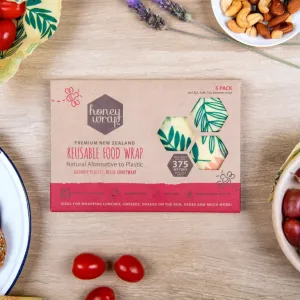
Eco-friendly Beeswax Wraps Honeywrap 5-Pack keeps food fresh naturally with reusable, breathable beeswax wraps.
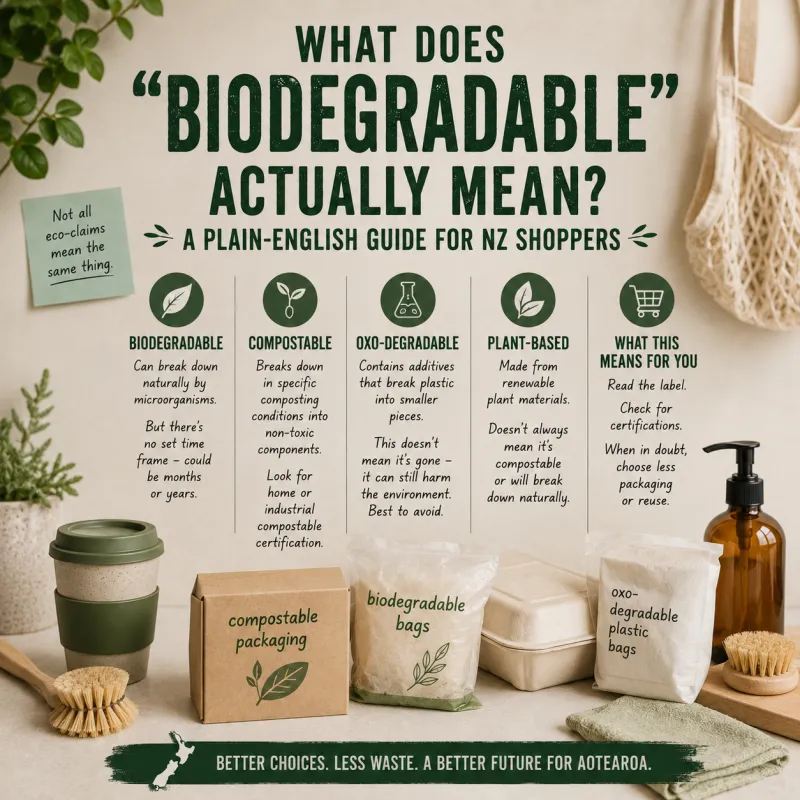
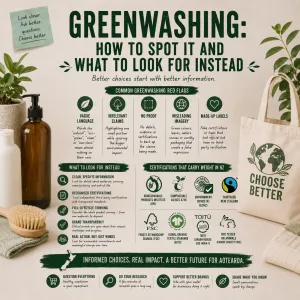
"Biodegradable" is one of the most commonly misused words in sustainable product marketing. It appears on products that take decades to break down under specific industrial conditions, on products that shed microplastics as they degrade, and occasionally on products that actually do compost safely at home. The word by itself tells you almost nothing useful.
This guide explains what the main terms actually mean so you can make better decisions when you're shopping.
Technically, almost everything is biodegradable given enough time and the right conditions. Conventional plastic is technically biodegradable, but it breaks down over hundreds of years into microplastic particles, not into something harmless. A plastic bag labelled biodegradable might take exactly as long to break down as one that doesn't have the label.
When a product says biodegradable without any further specification, it tells you very little. The more useful questions are: how long does it take, under what conditions, and what does it break down into?
Compostable has more meaning, but it still comes with conditions. Products certified to industrial composting standards (like EN 13432 in Europe) will break down correctly in a commercial composting facility at high temperatures. This is not the same as your home compost pile.
Home-compostable is the standard that actually matters for most households. Products certified to home composting standards will break down in a regular backyard compost bin at lower temperatures and over a longer period. Look for this specific certification if you want to compost something at home. A good example is the Compostic home-compostable cling wrap, which is certified for home composting and can go in your backyard bin at end of life.
In New Zealand, industrial composting infrastructure is limited, which means anything that requires industrial composting to actually break down is likely to end up in landfill anyway, where it won't have the right conditions.
This one is worth being cautious about. Oxo-degradable plastics are conventional plastics with an additive that causes them to fragment into smaller pieces when exposed to oxygen and heat. The problem is that fragmentation is not the same as biodegradation. The result is small plastic fragments, which are potentially more problematic than larger pieces because they're harder to collect and more easily ingested by wildlife. Oxo-degradable plastics are banned in the EU and are generally considered a greenwashing claim.
A product made from plant-based materials is not automatically compostable, biodegradable, or better for the environment. Bioplastics made from corn or sugarcane can require industrial composting to break down, and the production process has its own environmental footprint. Plant-based is a materials claim, not an end-of-life claim.
When you're buying a product and the packaging claims suggest it's environmentally friendly, the most useful thing to check is whether there's a third-party certification. In NZ and Australia, look for the Australasian Bioplastics Association certification, which covers both industrial and home composting standards. For other products, certifications from recognised bodies give the claim some substance.
Beyond that, the cleanest option is always a product that doesn't need to be disposed of at all. Reusable cotton mesh produce bags have no end-of-life problem because they simply keep being used. A wooden dish brush with compostable bristles and a handle you can toss in the compost is genuinely low-waste. These are the products worth prioritising.
At EcoWarehouse we try to be specific about why each product is stocked and what its actual environmental benefit is. If you're ever unsure about a product in our range, get in touch and we'll tell you exactly what we know about it.
*Note: Free shipping applies to all first-time orders within New Zealand.
For bulky items or rural delivery, there will be a small surcharge to help us cover the higher courier fees.
It is our responsibility to protect your privacy and we guarantee that your data will be completely confidential.
Please sign in first.
Sign in
Create a free account to use wishlists.
Sign inPlease sign in first.
Sign in