
NZ$79.90
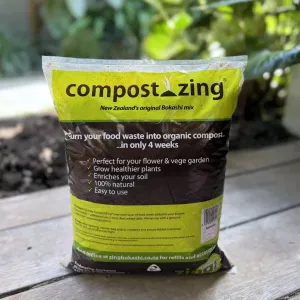
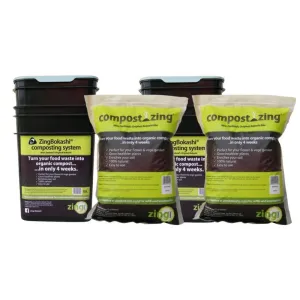
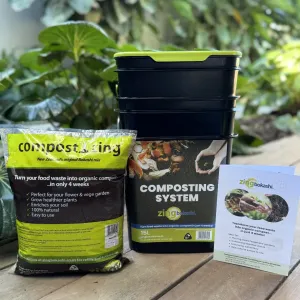
Effortlessly turn kitchen waste into nutrient-rich compost with this easy 15-litre Bokashi Starter Kit and Compost-Zing.
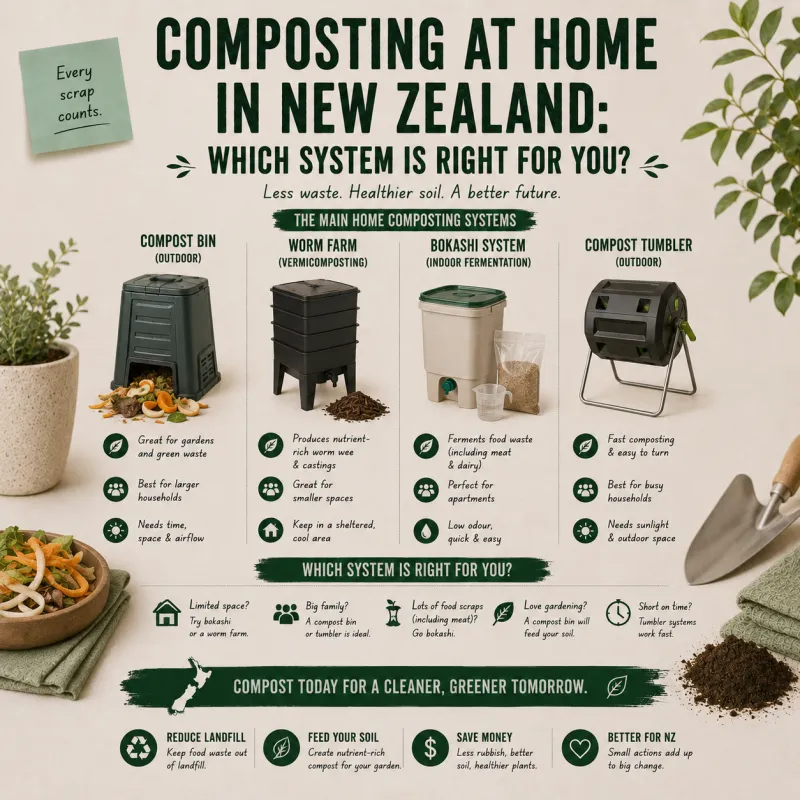
Around a third of household waste by weight is organic material that could be composted rather than landfilled. In landfill, this organic material breaks down anaerobically and produces methane, which is a significantly more potent greenhouse gas than carbon dioxide. Composting the same material instead produces a useful soil amendment and no methane.
New Zealand has a good climate for composting and a gardening culture that makes use of the output. The barrier for most households is usually practical rather than motivational: which system, how much space, and what can actually go in it?
Here's a rundown of the main options.
The classic approach. A compost bin or heap handles garden clippings, fruit and vegetable scraps, cardboard, paper, and similar materials. The result, after 3 to 6 months depending on conditions and management, is dark, rich compost that's excellent for gardens.
The main limitation is what it can't handle. A standard backyard compost heap will not cope well with cooked food, meat, fish, or dairy. These items can attract pests and will smell unpleasant if added. They can also slow the composting process if added in quantity.
For households with a garden and primarily plant-based food waste, an outdoor bin or heap is the simplest and cheapest option. Adding EM-1 effective microorganisms liquid to your heap accelerates the breakdown and improves the quality of the finished compost.
Bokashi is a fermentation-based system originally developed in Japan. It uses a sealed bucket and a bran inoculated with effective microorganisms. You add food scraps, including cooked food, meat, fish, and dairy, in thin layers with a sprinkle of bokashi bran between layers. The system ferments rather than decomposes, so it's odourless when sealed and fast. A full bucket typically takes 2 to 4 weeks to ferment.
The output from the bokashi bucket is pre-compost. It's pickled food waste that still needs to be buried in the garden or added to an outdoor compost heap to complete its breakdown. The liquid that drains from the bucket is a useful plant fertiliser when diluted.
Bokashi is particularly good for households in apartments or without a garden, or for households with children or pets who eat a wide variety of foods and generate cooked food waste. The sealed system means no odour and no pest attraction.
EcoWarehouse stocks bokashi systems including the 15-litre bokashi starter kit and a twin kit (2x 15-litre buckets) for households that generate more food waste. Replacement bokashi bran is also available separately.
A worm farm uses composting worms (not earthworms) to process food scraps into worm castings (a highly concentrated plant food) and liquid fertiliser. The castings are among the most nutrient-rich soil amendments available and are valued by serious gardeners.
Worm farms handle most fruit and vegetable scraps well but generally don't cope with citrus, onion, meat, or dairy in quantity. They require some management to keep the worm population healthy and the conditions right. They're excellent for households that want a high-quality compost output and are willing to spend a bit of time managing the system.
The most complete solution for most NZ households is a combination of bokashi for cooked food and meat scraps, and an outdoor compost heap or bin for garden clippings, cardboard, and raw vegetable scraps. The bokashi pre-compost gets buried in the garden or added to the outdoor heap. Between the two systems, essentially all household organic waste is handled.
Compost improves soil structure, adds nutrients, and supports microbial life in the soil. If you have a garden, you'll use it. If you don't, many community gardens accept donations of finished compost, and neighbours with gardens are often very happy to receive it.
The shift from sending food waste to landfill to composting it is one of the highest-impact sustainable changes a NZ household can make, both for reducing methane emissions and for building healthier soil in the garden.
Browse composting systems and gardening products at ecowarehouse.nz.
*Note: Free shipping applies to all first-time orders within New Zealand.
For bulky items or rural delivery, there will be a small surcharge to help us cover the higher courier fees.
It is our responsibility to protect your privacy and we guarantee that your data will be completely confidential.
Please sign in first.
Sign in
Create a free account to use wishlists.
Sign inPlease sign in first.
Sign in